Work Packages
The work plan and interactions between the work packages are displayed in figure “Overall structure of the work plan” with 6 technical work packages, one subjected to project management and one to dissemination and exploitation. In the technical work packages two demonstrators Hollow Electrode Loose Plate rSOC stack (demonstrator 1) and monolithic SOFC bundle (demonstrator 2) are developed. While demonstrator 1 will be produced both by CIM and MMJ, due its more elaborated design, demonstrator 2 will be produced exclusively by additive manufacturing techniques MMJ and VPP.
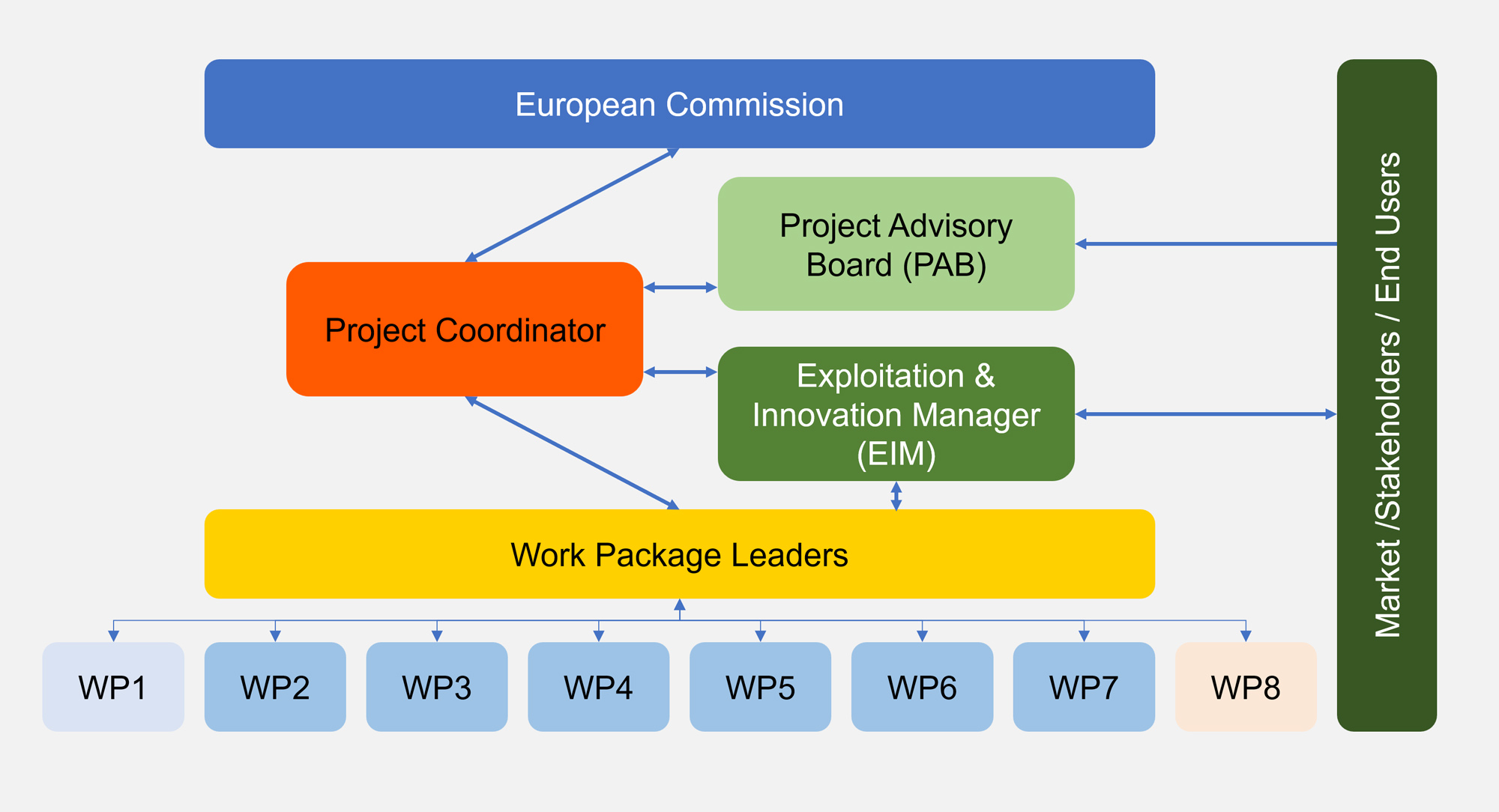
Overall structure of the work plan
The first work package, Project Management, is essential for ensuring effective coordination and admin-istration throughout the project lifecycle. This package encompasses regular meetings, progress tracking, and report-ing, which are critical in maintaining alignment among all partners.
In WP2 Component Design and Modelling the requirements for single and multi-material components are defined, modelling of the component is performed to optimize the shape using a digital twin. Resulting geometries and process strategies will be fed into WP3 and WP4 for developing the components and into WP7 to start set up the process model.
WP3 Additive Manufacturing will deal with the development of the process platforms of VPP and MMJ, using the demonstrators 1 and 2. They will incorporate the modelling results from WP2, and deliver process expertise for upscaling in WP5. Gathered process information will be incorporated in WP7.
WP4 Ceramic Injection Moulding is a complementary work package to WP3 where the ceramic injection moulding platform will be developed for demonstrator 1. Non-wovens will be implemented by the process variant In-Mould-Labelling (IML) and surface structuring will be performed by In-Mould-Embossing (IME). For tooling the results of WP2 will be applied. The process expertise for upscaling will be delivered to WP5. Gathered process information will be incorporated in WP7.
WP 5 Process Upscaling and Cell Fabrication is dedicated to enabling the production of SOC parts at quantities relevant for practical usage and pre-industrialization. Process information will be provided by WP3 and WP4. The produced parts will be stacked and tested in WP6. Collected process data will be delivered for process evaluation in WP7.
WP6 Testing and Demonstration: Starting with half cells from WP3 and WP4 first assembly tests will be performed. Finally, stacks built with components from WP5 will be evaluated concerning their electrochemical per-formance and the demonstrators will be validated, feeding further information into WP7.
In WP 7 Process Visualization and Life Cycle Assessment, the software framework for AI-based methods will be developed, which support the process visualization, monitoring, and LCA assessment. The process model is based on the data provided by WP2, WP3, WP4, WP5 and WP6.
WP8, Dissemination and Exploitation, aims to promote project outcomes to target audiences. It includes the development of communication materials, a social media campaign, and public workshops. It ensures the long-term viability of the project results. All WPs will interact with WP8 to ensure dissemination activities in all develop-ment stages. Feedback from the dissemination efforts can influence the research and development cycle, ensuring that the solutions meet user needs.